This transcript features Torsten Slok, partner and chief economist at Apollo, presenting a bold thesis on how AI is reshaping the entire U.S. economy and financial markets. The core argument is that AI has become the dominant factor across all asset classes, effectively replacing traditional diversification. Slok identifies three powerful, policy-driven tailwinds that are making the U.S. economy uniquely resilient to Federal Reserve interest rate changes: the AI/data center buildout, an industrial renaissance (including the CHIPS Act and reshoring), and the "one big beautiful bill" (tax cuts). He argues that these forces are so potent that they will continue to drive growth regardless of whether the Fed cuts or raises rates [Ref 1, Ref 2, Ref 21, Ref 22].
The presentation uses a series of charts to illustrate these points. One chart shows the massive scale of data center construction, with roughly 3,000 new centers announced or under construction compared to 4,000 existing ones [Ref 10, Ref 11]. Another chart breaks down the engines of U.S. growth, attributing a full one percentage point to AI-driven productivity gains by 2026, alongside the industrial renaissance and the tax cut bill [Ref 13, Ref 14, Ref 15, Ref 16, Ref 17]. Slok emphasizes that the "one big beautiful bill" will provide a significant consumer spending boost of over $100 billion in the six months leading up to the midterm elections [Ref 19].
Despite this strong growth outlook, Slok warns that inflation is expected to rise from 2.7% to 3.7% and only return to the Fed's 2% target by mid-2027 [Ref 28, Ref 29]. This "higher for longer" inflation makes it very difficult for the Fed to cut rates, with some FOMC members even suggesting rate hikes [Ref 30]. This creates a complex backdrop where growth is strong but rates remain elevated.
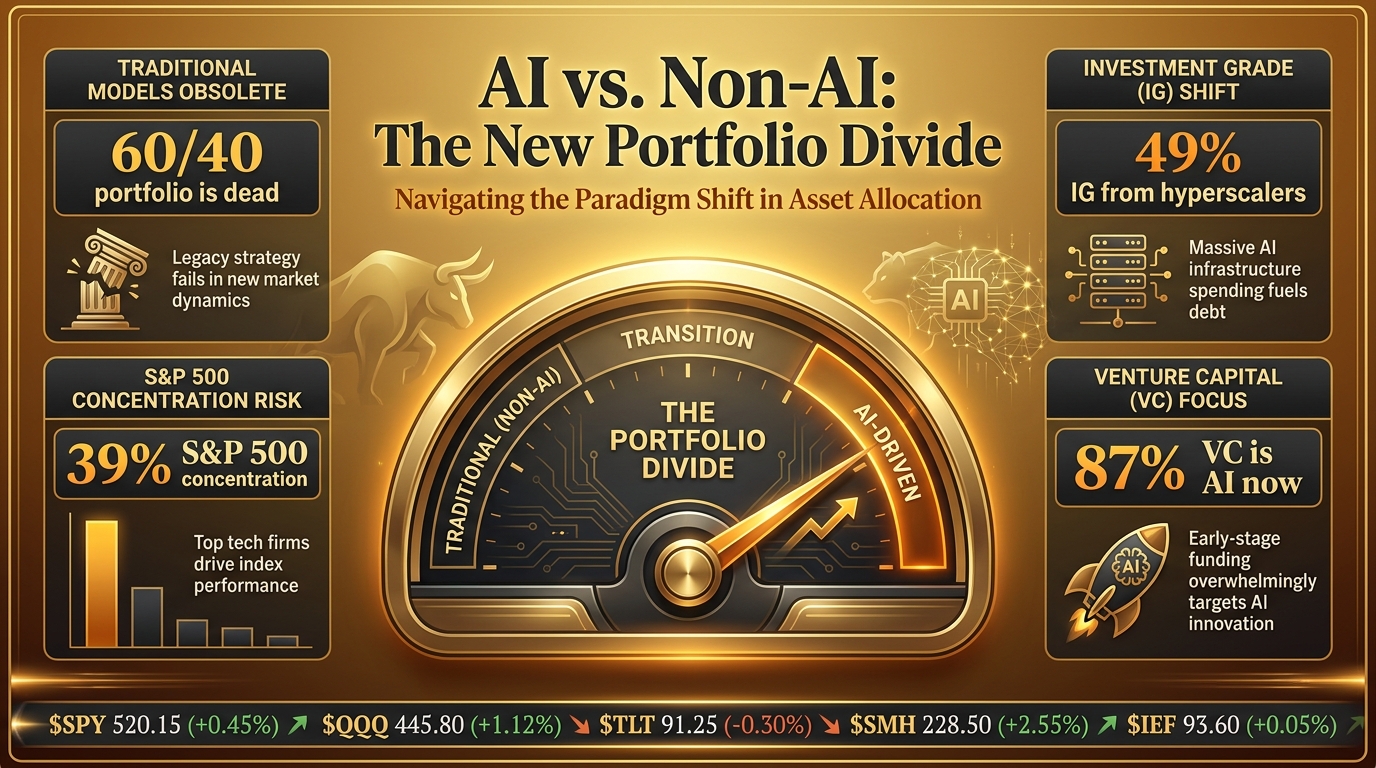
The most critical insight for investors is that AI has infiltrated every corner of a traditional 60/40 portfolio. The top ten stocks in the S&P 500 now make up 39% of the index, making it a concentrated bet on AI [Ref 34]. In fixed income, 49% of year-to-date investment-grade issuance is from hyperscalers funding data centers [Ref 35, Ref 36]. Even venture capital is now 87% AI-focused [Ref 37]. This means investors are exposed to a single factor—AI—across both equities and bonds, undermining the diversification benefits of the classic 60/40 model [Ref 38, Ref 39, Ref 40]. Slok concludes that the new portfolio construction must consider exposure to both "AI" and "non-AI" assets [Ref 41]. He also notes that the massive issuance from hyperscalers is putting upward pressure on bond yields, alongside Treasury issuance and inflation [Ref 42]. The ultimate risk, he states, is that if AI fails to deliver on its promises, both GDP growth and portfolio values (in both equities and fixed income) would be at risk [Ref 46].
-
AI as the Dominant Economic Driver: AI is the primary engine of U.S. economic growth, driven by data center buildout and associated energy spending, with early signs of productivity gains expected to add one percentage point to GDP growth in 2026 [Ref 13].
-
Policy-Driven Tailwinds Override Fed Policy: The AI boom, industrial renaissance (reshoring), and the "one big beautiful bill" (tax cuts) are powerful forces that will continue to drive growth irrespective of whether the Fed raises or lowers interest rates [Ref 1, Ref 2, Ref 21, Ref 22].
-
Inflation and Rates "Higher for Longer": The consensus forecast shows inflation rising from 2.7% to 3.7%, making it very difficult for the Fed to cut rates. Some FOMC members are even considering rate hikes [Ref 28, Ref 29, Ref 30].
-
The Death of Diversification (60/40): AI is now the single dominant factor in both equity and fixed income portfolios. The top 10 S&P 500 stocks make up 39% of the index, and 49% of investment-grade bond issuance is from hyperscalers [Ref 34, Ref 35, Ref 36].
-
AI's Pervasiveness Across Asset Classes: AI's influence extends beyond equities to investment-grade credit, high-yield bonds, and venture capital, where 87% of VC funding is now AI-related [Ref 35, Ref 36, Ref 37].
-
Upward Pressure on Yields: Yields are under pressure from multiple sources: inflation (front end), hyperscaler bond issuance (belly), and Treasury issuance (long end) [Ref 42].
-
Unique U.S. Economic Position: The U.S. economy benefits from unique tailwinds (AI, industrial renaissance, tax cuts) that Europe and the rest of the world do not have [Ref 23, Ref 24].
-
Consumer Spending Boost from Tax Cuts: The "one big beautiful bill" will provide households with an average tax refund of $4,000 in 2025, leading to over $100 billion in consumer spending over the next six months [Ref 18, Ref 19].
-
Strong Labor Market: Nonfarm payrolls are expected to be very strong, supported by ADP data showing 30-40,000 jobs created per month [Ref 22, Ref 23].
-
The "AI vs. Non-AI" Portfolio: The new portfolio construction challenge is to ensure exposure to both AI and non-AI assets, rather than relying on a traditional 60/40 split [Ref 40, Ref 41].
-
Concentration Risk is Systemic: The transcript highlights a profound concentration risk where a single factor (AI) dominates both equity and fixed income markets. This undermines the fundamental principle of diversification in a 60/40 portfolio, creating a fragile structure where a downturn in AI would impact all holdings simultaneously [Ref 38, Ref 39, Ref 40].
-
The "Higher for Longer" Stagflationary Mix: The combination of strong growth (driven by policy) and rising inflation creates a stagflationary-like environment for financial assets. This is particularly challenging for bonds, as yields are pushed up by both inflation and supply (from hyperscalers and Treasuries) [Ref 28, Ref 29, Ref 42].
-
Policy Dependency Creates a Binary Outcome: The U.S. economy's fate is heavily tied to the success of AI and the continuation of government spending (CHIPS Act, tax cuts). This creates a binary risk: if AI disappoints or policy changes, the powerful tailwinds could quickly reverse, leading to a sharp economic slowdown [Ref 46].
-
The Fed is Effectively "Boxed In": The strong growth and rising inflation profile make it nearly impossible for the Fed to cut rates, despite potential market expectations. This could lead to a policy error if the economy slows unexpectedly while inflation remains sticky [Ref 29, Ref 30].
-
Hyperscaler Issuance is a New Market Dynamic: The massive bond issuance from hyperscalers is a new and significant factor in the fixed income market. It acts as a substitute for Treasuries, adding to supply and putting structural upward pressure on yields, independent of Fed policy [Ref 35, Ref 36, Ref 42].
-
Implicit Bull Case for AI-Exposed Assets: The strongest bullish case is for assets directly tied to the AI buildout, including the hyperscalers themselves and the broader tech sector. The transcript implies that these are the primary beneficiaries of the current economic regime [Ref 34, Ref 35, Ref 36].
-
Risk of a "Narrative Reversal": The entire market narrative is built on the AI promise. A negative surprise (e.g., a major AI project failure, regulatory crackdown, or a sharp slowdown in data center spending) could trigger a violent repricing of risk across all asset classes [Ref 46].
- Review portfolio concentration to quantify total exposure to the AI factor across all asset classes (equities, IG credit, HY, VC) [Ref 38, Ref 39, Ref 40].
- Monitor upcoming nonfarm payrolls data for confirmation of the strong labor market thesis [Ref 22, Ref 23].
- Assess the impact of the "one big beautiful bill" tax refunds on consumer discretionary spending and retail sectors [Ref 18, Ref 19].
- Evaluate the duration and credit risk in bond portfolios given the upward pressure on yields from hyperscaler and Treasury issuance [Ref 42].
- Begin constructing a portfolio that explicitly separates "AI" and "non-AI" exposures to restore diversification [Ref 40, Ref 41].
- Increase allocation to "non-AI" assets that could benefit from the industrial renaissance (e.g., domestic manufacturing, defense, pharma reshoring) [Ref 14, Ref 15, Ref 16].
- Hedge against the risk of "higher for longer" inflation and rates by reducing duration in fixed income portfolios [Ref 28, Ref 29, Ref 30].
- Consider tactical short positions on long-duration Treasuries (TLT) and intermediate-term bonds (IEF) given the structural yield pressures [Ref 42].
- Develop a scenario analysis for a potential AI "failure" and its impact on GDP and portfolio values, and implement hedging strategies accordingly [Ref 46].
- Shift strategic asset allocation away from the traditional 60/40 model towards a factor-based approach that accounts for the AI/non-AI divide [Ref 40, Ref 41].
- Monitor the trajectory of inflation and Fed policy for a potential pivot, which would be a major regime change for all asset classes [Ref 29, Ref 30].
- Increase exposure to real assets and commodities (e.g., energy, copper) that are direct beneficiaries of the data center buildout and electrification [Ref 13].
-
AI Disappointment: The single biggest risk is that the massive investment in AI does not deliver the promised productivity gains or revenue growth, leading to a sharp slowdown in capital spending and a collapse in AI-related asset prices [Ref 46].
-
Inflation Surprise: The forecast of rising inflation could be wrong. If inflation falls faster than expected, the Fed could cut rates, which would be a positive for bonds but could also signal a weaker economy [Ref 28, Ref 29].
-
Geopolitical Risk: The transcript mentions the Strait of Hormuz as a potential source of higher inflation, but the specific impact is not detailed [Ref 44].
-
Policy Reversal: The "one big beautiful bill" and the CHIPS Act are assumed to be ongoing. A political shift or fiscal constraint could lead to a reversal or scaling back of these policies [Ref 14, Ref 17].
-
Credit Market Disruption: The massive issuance from hyperscalers could lead to indigestion in the investment-grade credit market, causing spreads to widen and potentially crowding out other borrowers [Ref 35, Ref 36].
-
Labor Market Slowdown: While the near-term outlook is strong, a sudden weakening in the labor market is a risk that is not fully addressed in the transcript [Ref 22, Ref 23].
-
Specific Ticker Performance: The transcript does not discuss the performance or valuation of any specific stock tickers.
-
Impact on Non-U.S. Markets: The transcript notes that Europe lacks the U.S. tailwinds, but does not analyze the specific risks or opportunities in other global markets [Ref 23, Ref 24].
[TICKERS]: SPY, QQQ, IWM, TLT, IEF, SHY, DX-Y.NYB, ^VIX, GLD, SLV, CPER, USO, UNG, URA, ITB, SMH, XLF, ^DJT
Sources covered: Torsten Slok Shows Us How AI Is Eating the Entire US Economy | Odd Lots